On ESGTransformation.com, sustainable development is considered a consequence of the transformation of economic practices—a transformation from linear to circular business practices.
The X-curve of transition
By doing the right things in production, procurement, sales and logistics, both responsible and profitable business can walk hand in hand. Doing things right, if not already, also means ceasing or phasing out the wrong things.
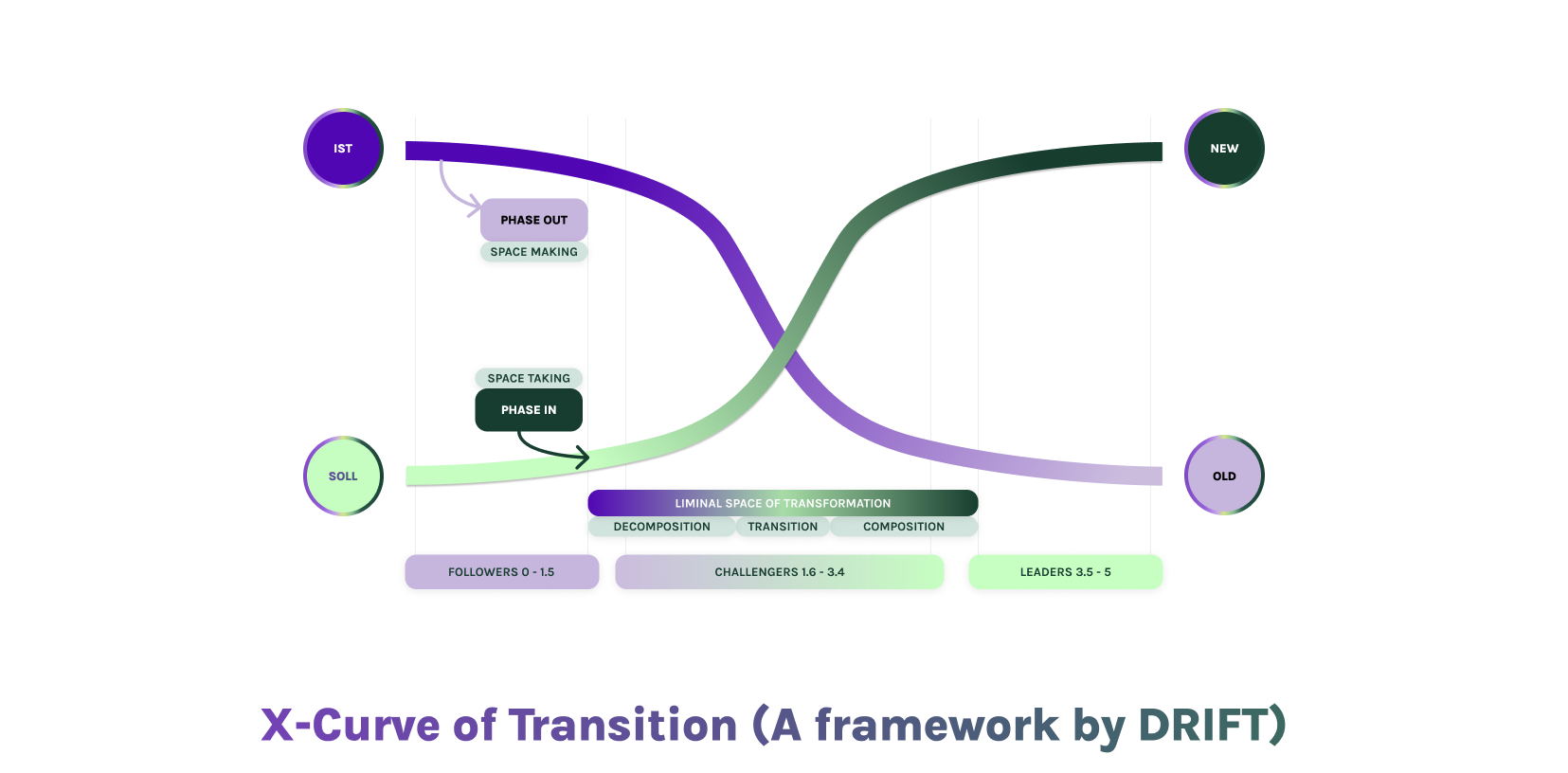
DRIFT and EIT Climate-KIC Transitions Hub created a toolkit that is aimed at producing practice-based knowledge on sustainability transitions. While this toolkit aims to clarify how transformation or transition works on a systems level, this chapter of the handbook aims to illustrate how it could also be used to manage single business transformation.
Creation and destruction: compose and decompose
Transformation involves a constant interplay of creation and destruction. It's about building up new, sustainable ways of doing things while simultaneously breaking down old, harmful practices. Every transition has patterns of destruction and patterns of creation. The patterns of creation focus on developing new ways of thinking, working, and organising.
These patterns of creation and destruction line up for and include the principles of the circular economy: reciprocity and temporality. The system of giving and taking can only transform effectively when current ways of thinking, working and organising can be seen as temporary constructs that can be decomposed and recomposed.
Liminality: the phase between the old and the new
Anthropologists have an expression that is a warning for transformation strategies: "Culture eats strategy for breakfast". Transformation is not a straight line in any way. The X-Curve for that matter will never be as smooth as illustrated in the picture. A transformation strategy is more or less a directional compass that takes the cultural upper current (formal) and the under current (informal) into account.
Although transformation is a constant in life, both predictable and unpredictable, business transformation is with strategic intend. You can make plans, based on a vision and a mission. The phase that is ignited by this intend is what is referred to by anthropologist Jitske Kramer, "the messy middle of change", also known as liminality
Liminality is the phase where the upper current and under current are negotiating new meaning. Pushing strategy without attention to and involvement of the under current will almost certainly organise the resistence against the transformation intend. Before going head first into the X-Curve, creating space for the cultural process is crucial.
Creating space: sidetrack experiments
...
Phasing in and phasing out
PHASE IN
Building up new activities and practises can start small. It is import to have some small but quick wins to engage colleagues. At the same time you want to avoid negative energy as much as possible. so doing new things should go at the expense of old ways.
PHASE OUT
Without a proper phase out plan of old ways, there will not be enough space for new activities without increasing the work pressure. Building up and breaking down activities can be planned around some balance. The ESG framework in combination with the predictive value of your company's data is the best guide for strategy and transformation.
